
Free HVAC Tool
HVAC Energy Cost Calculator
Find out exactly how much your air conditioner costs to run — per day, per month, and per season. Enter your system size, SEER rating, and electricity rate for an instant estimate.
Built by SubcontractorHub — the software HVAC contractors use to quote, finance, and run every job.
Book a Demo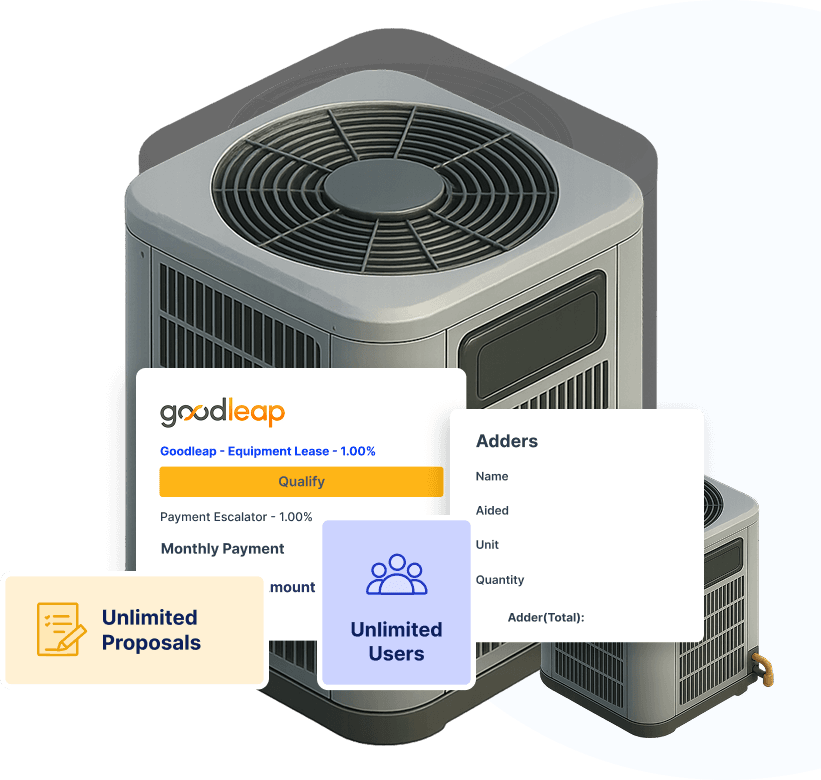
How Much Does It Cost to Run Your AC?
Select your system capacity and SEER rating, then adjust usage hours and your electricity rate. Results update instantly.
US average is $0.13–$0.16/kWh. Find yours on your electric bill.
Estimated monthly cost
$81
per month during cooling season (8 hrs/day × 30 days)
Daily cost
$3
18 kWh/day
Seasonal cost
$324
4 months × $81/mo
vs. SEER 10 savings
+$194
per season vs. SEER 10
Capacity
3.0 tons
SEER
16
kW draw
2.3 kW
Rate
$0.15/kWh
Ballpark estimate only
These figures are rough estimates based on nameplate ratings and simple formulas. Actual energy use depends on thermostat setpoints, local design temperatures, home insulation, duct condition, refrigerant charge, and equipment age. Real-world energy use may vary 20–40% from these estimates.
📋 Important: All calculator results are ballpark estimates
These figures are approximate estimates based on nameplate ratings and simplified formulas. Actual energy use depends on thermostat setpoints, home insulation, duct condition, and equipment condition. Always confirm energy use with your utility bill or a licensed HVAC technician.
How to Use This Calculator
Select your system capacity
System capacity is measured in tons (1 ton = 12,000 BTU/hr). Check your outdoor AC unit — the model number typically encodes capacity (e.g., a model number containing 036 = 36,000 BTU = 3 tons). If you don't know your system size, a 3-ton system is the most common for homes in the 2,000–2,600 sq ft range.
Enter your SEER rating
SEER (Seasonal Energy Efficiency Ratio) is printed on the yellow EnergyGuide label on your outdoor unit. Older systems installed before 2006 are often SEER 10 or below. Systems installed 2006–2022 are typically SEER 13–16. New systems sold since 2023 use SEER2 ratings. If you don't know your SEER, choose SEER 14 as a reasonable estimate for a system installed 2010–2022.
Set your daily usage hours
This is how many hours per day your system runs (compressor on), not how many hours the thermostat calls for cooling. During peak summer heat, a properly sized system may run 12–16 hours. A unit running nearly 24/7 in summer heat suggests it may be undersized or the home has envelope issues.
Enter your electricity rate
Your electricity rate ($/kWh) is on your monthly utility bill — look for the line that shows kWh used and total charge, then divide to get $/kWh. The US average is around $0.14–$0.16/kWh. Hawaiian households often pay $0.35+ per kWh while Midwestern states may be as low as $0.09.
Set your cooling months
Enter how many months per year you run your central AC. Florida homeowners may cool all 12 months; Minnesota homeowners may only need 3–4 months. This drives the seasonal total and helps you see the full-year picture.
What Affects Your Air Conditioner's Energy Cost
SEER rating
The single biggest lever in your control. A SEER 20 system uses exactly half the electricity of a SEER 10 system to deliver the same cooling. Upgrading from an old SEER 10 unit to a new SEER 18 unit cuts your AC bill by 44%.
System size (tons)
Larger systems use more power per hour but may run fewer hours if properly sized. An oversized system short-cycles — it cools quickly, shuts off, then turns back on repeatedly. Short-cycling is less efficient than a longer continuous run and puts more wear on the compressor.
Thermostat setpoint
Every degree you raise the setpoint saves roughly 3–4% in cooling costs. Setting your thermostat to 78°F instead of 72°F can cut your cooling bill by 18–24%. A programmable thermostat that raises setpoints during unoccupied hours is one of the fastest payback investments in home efficiency.
Home insulation and air sealing
A well-insulated, tightly sealed home is easier to keep cool. The AC runs fewer hours because the home gains heat more slowly. Attic insulation and weatherstripping are the highest-impact upgrades for reducing AC runtime.
Refrigerant charge and coil condition
A system with low refrigerant runs longer to achieve the same cooling and uses more energy. Dirty evaporator or condenser coils reduce heat transfer efficiency, raising energy use 10–25%. Annual tune-ups maintain peak efficiency.
Duct leakage
In a typical ducted system, 20–30% of conditioned air leaks into unconditioned attic or crawl space. Sealing duct leaks is one of the most cost-effective ways to reduce HVAC energy costs without replacing equipment.
From Load Numbers to a Signed Proposal
When a homeowner sees exactly how much their SEER 10 system is costing them each month, upgrading to a high-efficiency unit becomes an easy financial decision — not a reluctant purchase. SubcontractorHub's EasyQuote shows customers the efficiency comparison, equipment options, and monthly financing payments in a single proposal you build right at their home.
Integrated financing from GoodLeap and Service Finance means customers can approve and sign on the spot. HVAC contractors report 20–30% higher close rates when financing is shown alongside the energy savings payback.
See How It WorksBuild side-by-side efficiency proposals on a tablet
Show monthly savings vs. current SEER rating
Include financing payments from multiple lenders
Customer approves and signs before you leave the home
Job flows directly to your operations team
Common Questions About AC Energy Costs
How much does it cost to run an air conditioner per month?
For a typical 3-ton (36,000 BTU) central AC with a SEER 14 rating running 8 hours per day at $0.15/kWh, expect to pay roughly $75–$100/month during peak cooling season. A 2-ton window unit running the same hours costs around $45–$65/month. Your actual cost depends on your system's SEER rating (higher = more efficient), capacity, local electricity rate, how many hours per day it runs, and how many months you cool your home.
What is SEER rating and how does it affect energy costs?
SEER (Seasonal Energy Efficiency Ratio) measures how many BTUs of cooling an air conditioner delivers per watt-hour of electricity consumed over a full season. A SEER 20 system uses exactly half the electricity of a SEER 10 system to deliver the same cooling. Upgrading from SEER 10 to SEER 20 cuts your AC energy bill by 50%. Modern systems range from SEER 13 (federal minimum) to SEER 26+ for premium variable-speed units. In 2023, the US adopted SEER2 ratings which measure performance under slightly different test conditions.
How do I calculate my air conditioner's energy use?
The formula is: kWh per hour = (BTU capacity ÷ SEER) ÷ 1000. Then multiply by hours of operation to get daily kWh. Multiply by your electricity rate (in $/kWh) for daily cost. Example: A 3-ton (36,000 BTU) SEER 16 unit running 8 hours = (36,000 ÷ 16) ÷ 1000 × 8 = 18 kWh/day. At $0.14/kWh that's $2.52/day or about $76/month during cooling season.
What is the average electricity rate in the US?
The US average residential electricity rate is approximately $0.13–$0.16/kWh as of 2024–2026. Rates vary significantly by state: Hawaii and California often exceed $0.25/kWh, while states like Oklahoma, Louisiana, and Arkansas average $0.09–$0.11/kWh. Check your utility bill for your actual rate — it's listed as $/kWh in the usage section.
How many hours per day does a central air conditioner typically run?
A properly sized central AC system typically runs 12–16 hours per day on the hottest summer days and 6–10 hours per day during mild weather. Poorly insulated homes, oversized systems (which short-cycle), or systems with dirty filters may run more than they should. An inverter-driven or variable-speed system runs nearly continuously at reduced capacity, which is more efficient than cycling on and off at full blast.
What's the most effective way to reduce AC energy costs?
In order of impact: (1) Upgrade to a high-SEER system — going from SEER 10 to SEER 20 cuts cooling costs in half. (2) Add attic insulation — keeping heat out reduces how hard the system works. (3) Use a programmable thermostat to raise setpoint when the home is unoccupied. (4) Seal duct leaks — 20–30% of conditioned air escapes in a typical ducted system. (5) Replace air filters monthly during heavy-use months. (6) Have the system tuned annually — dirty coils and low refrigerant reduce efficiency significantly.
Quote, Finance, and Install Every System in One Platform
SubcontractorHub gives HVAC contractors a full sales platform — proposals with energy savings comparisons, integrated financing, and operations handoff in one place.
Book a Free DemoAll calculations are estimates based on historical information and should be verified by the user. This tool is provided as a free service for planning purposes only and is not a substitute for a professional assessment, a supplier quote, or applicable local code requirements.