
Best HVAC Inventory Management Software and Apps for Contractors in 2026
Published July 2026 · Updated August 2026 · 10 min read
Parts don't just sit in a warehouse — they move through jobs. The equipment you quote, the materials you order, and the substitutions your crew makes on-site all add up to the single biggest variable cost on an HVAC installation. Inventory management software is how you keep that cost from quietly eroding your margin.
But "inventory software" means different things to different HVAC businesses. A large service shop stocking multiple trucks needs warehouse-to-truck tracking with reorder points and serial numbers. An installation contractor who orders equipment per job needs something else entirely: parts tied to the proposal and the project, so material cost stays accurate. This guide covers the best HVAC inventory management software for both models in 2026 — and which one fits how you actually buy and consume parts.

The equipment on the proposal is the material baseline for the job — inventory software should keep the two connected.
What to Look for in HVAC Inventory Management Software
Before comparing platforms, know which of these capabilities actually matter for your business:
- Parts tied to jobs: every unit and material should link to the job that consumes it — otherwise cost never ties back to the sale
- Purchase order management: create and track POs per job or per vendor, with received quantities logged against what was ordered
- Warehouse and truck stock (service shops only): real-time quantity on hand across locations, reorder points, and serial-number tracking
- Material cost into job costing: parts cost should feed job margin automatically, not require a separate reconciliation
- Substitution and variance tracking: when the crew swaps a quoted unit, the cost delta should be visible during the job
- Financing cost visibility: on financed installs, dealer fees affect true margin — the platform should account for them alongside material cost
Installation contractors already running HVAC contractor software connected to their sales pipeline have an edge: the quoted bill of materials flows into the project, so parts are tracked against the estimate from day one. Standalone stockroom tools rarely make that connection.
SubcontractorHub
See How Top Contractors Close More Jobs
AI proposals, sales pipeline, and project management — all in one platform.
- ✓AI-powered proposals in the field
- ✓CRM built for contractor sales
- ✓Project tracking from sale to install
30 minutes. No commitment.
HVAC Inventory Management Software Comparison (2026)
| Platform | Inventory Model | Parts Tied to Jobs | Purchase Orders | Feeds Job Margin | Starting Price |
|---|---|---|---|---|---|
| SubcontractorHub | Per-job materials via proposal + project | Yes — from EasyQuote | Yes — per job | Yes — real time | Contact for pricing |
| ServiceTitan | Deep — warehouse-to-truck, serial numbers | Yes | Yes | Yes | $245–$400+/tech/mo |
| Simpro | Deep — multi-location stock, catalogs | Yes | Yes | Yes | Contact for pricing |
| Housecall Pro | Basic parts list & price book | Partial | Add-on | Profit Tracker (Essentials+) | From $149/mo |
| FieldEdge | Flat-rate price book + equipment tracking | Partial | Yes | Limited | Contact for pricing |
The 5 Best HVAC Inventory Management Software Options in 2026
1. SubcontractorHub — Best for Installation Contractors
SubcontractorHub approaches inventory from the sale, not the stockroom. When a rep builds a proposal in EasyQuote, the quoted equipment and materials become the material baseline for the installation project automatically when the deal closes. Purchase orders, delivered quantities, and substitutions then accumulate against that baseline through HVAC contractor software project management — so parts always tie back to the job that consumes them.
The payoff is margin protection. Material cost feeds job margin in real time alongside labor and financing dealer fees (GoodLeap, Sungage, LightReach), so managers catch an out-of-stock condenser swap during the job instead of at month-end close. For contractors who order per install rather than stocking trucks, this is the most integrated material-tracking workflow available in 2026. See it applied to HVAC contractor software built for installation businesses.
Best for: HVAC installation contractors who order equipment per job and need materials tied to proposals and projects.
Not ideal for: Service shops needing warehouse-to-truck stock with reorder points and serial numbers.
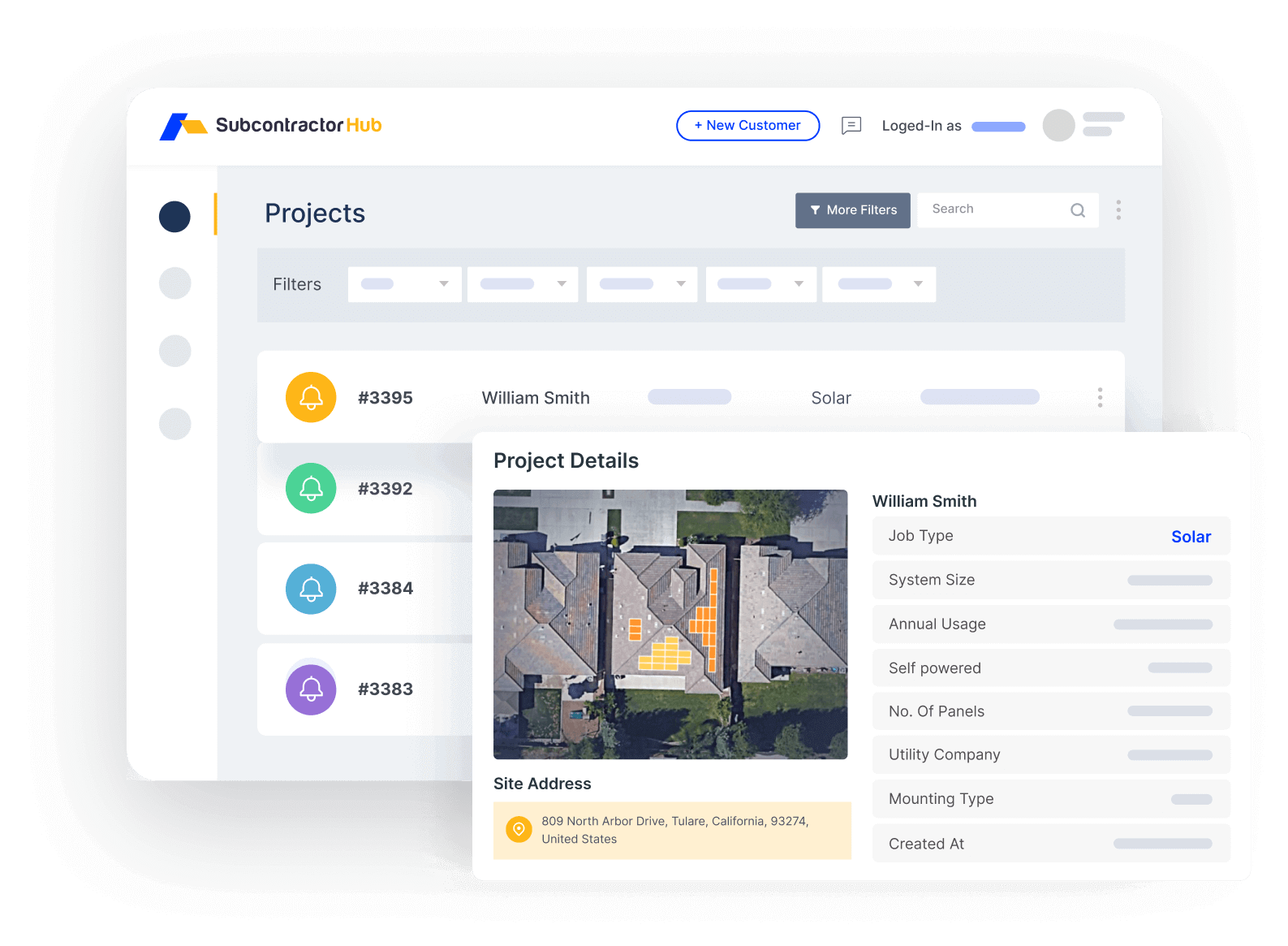
Purchase orders and material actuals accumulate against the quoted baseline — so material variance is visible during the job.
2. ServiceTitan — Best for Large Service Shops
ServiceTitan has the deepest inventory module in the HVAC industry — warehouse-to-truck stock levels, purchase orders, vendor management, and equipment serial-number tracking. If you run multiple stocked trucks and need to know exactly what's on each one in real time, ServiceTitan is the most capable platform on this list.
The tradeoff is cost and complexity: $245–$400+ per technician per month, plus a mandatory onboarding investment often in the $15,000–$25,000 range. For businesses under $3M in revenue, or those that order materials per install rather than stocking inventory, that depth is more than most shops will use.
Best for: HVAC service shops at $5M+ revenue stocking multiple trucks and a warehouse.
Not ideal for: Installation contractors who order equipment per job and need a sales pipeline.
3. Simpro — Best for Commercial & Multi-Location
Simpro offers native, real-time inventory across warehouses, vans, and job sites, with catalogs, purchase orders, and project-billing integration. For commercial HVAC and multi-trade contractors managing stock in more than one location, Simpro's inventory depth rivals ServiceTitan at a different price structure.
Best for: Commercial HVAC and multi-location contractors with real stock to manage.
Not ideal for: Residential installation shops that want AI proposals and a sales pipeline first.
4. Housecall Pro — Best for Small Service Teams
Housecall Pro keeps a basic parts list and price book, with a Profit Tracker on the Essentials plan ($149/month) that gives small residential shops a simple margin view. It's not full warehouse inventory, but it's accessible for businesses under $1M in revenue that need parts pricing and light cost visibility without an enterprise price tag.
Best for: Small residential HVAC service shops under $1M revenue.
Not ideal for: Installation contractors or shops needing true multi-location stock.
5. FieldEdge — Best for Trade-Specific Service Workflows
FieldEdge has built HVAC, plumbing, and electrical service software since 1979, with a flat-rate price book, equipment tracking, and strong QuickBooks Desktop sync. Its inventory features suit service-and-repair shops that live in a price book and want purchase orders tied to work orders, though it lacks the installation sales pipeline that D2D and inside-sales contractors rely on.
Best for: Service-and-repair HVAC shops that work from a flat-rate price book.
Not ideal for: Installation businesses running a structured proposal-driven sales process.
Why Installation Contractors Track Inventory Differently
Most inventory software is built around a warehouse: you stock parts, deplete them, and reorder. That model fits service shops that keep trucks loaded for same-day repairs. It fits installation contractors far less well, because installers usually order the specific equipment for a job after it sells — not off a shelf.
For installers, the question isn't "how many condensers are on truck three" — it's "did we buy this job's equipment at the price we quoted." A rep quotes a $2,400 unit. The original is backordered, so the crew orders a $2,800 substitute. Without materials tied to the estimate, that $400 gap disappears into a purchase-order pile and surfaces only when the books close — after it's repeated across 20 jobs.
The best HVAC inventory management software for installation contractors closes that gap by connecting parts to HVAC project management. When a job closes, the quoted materials become the baseline. Purchase orders and substitutions are logged against it, so material variance is visible in real time. That connection is also what turns inventory data into real HVAC job costing — because knowing what you bought only protects margin when it's measured against what you sold.
Wondering what platforms in this category cost? See our breakdown of HVAC software pricing in 2026.
The Bottom Line
The best HVAC inventory management software depends on how your business buys and consumes parts:
- Installation contractors (order equipment per job, run a sales process): SubcontractorHub ties materials to the proposal and the project, so cost and margin stay accurate without warehouse overhead.
- Large service shops stocking multiple trucks: ServiceTitan has the deepest warehouse-to-truck inventory, if you can justify the cost and onboarding.
- Commercial & multi-location: Simpro handles real stock across warehouses and vans better than residential-focused tools.
- Small service teams: Housecall Pro and FieldEdge cover parts pricing and basic tracking at an accessible entry point.
If you're an installation business and your materials live in a spreadsheet disconnected from your proposals and projects, the fix usually isn't a bolt-on inventory tool — it's a platform where parts, jobs, and margin already live together. See what HVAC inventory built into contractor software looks like in practice.
See How SubcontractorHub Ties Parts to Jobs
Book a demo and see how quoted materials become the job baseline — so material cost and margin stay accurate on every HVAC install.
Book a Free DemoHow to Set Truck Stock: The Part Every Inventory Tool Skips
Software will count what is on the van. It will not tell you what should be on the van, and that decision is where most HVAC inventory money is actually lost — either to second trips or to $40,000 of slow-moving stock spread across six trucks. The method below works regardless of which platform you pick.
- Pull twelve months of parts usage, not three. HVAC demand is seasonal in both directions — capacitors and contactors spike in July, heat exchangers and igniters in January. A quarter of data will stock your trucks for the wrong season.
- Sort by frequency, then cross-check by cost. Anything used on more than roughly one in five calls belongs on every truck. High-cost, low-frequency parts — compressors, board-level assemblies, ECM motors — belong at the shop or on a supplier will-call, never replicated across the fleet.
- Set min/max per truck, not per company. A maintenance tech and a install crew need different vans. One shared list guarantees both are wrong.
- Make replenishment automatic and tied to the job. The part has to leave inventory when the technician logs it on the work order, not when someone remembers at week's end. If consumption is not captured at the point of use, counts drift within a month and the system stops being trusted — which is the real failure mode, not the software.
- Reconcile with a rolling count. Ten to fifteen high-velocity SKUs per truck per month beats an annual full count nobody finishes. Variance on fast movers is where shrink actually shows up.
Purchase orders are the piece worth paying for. If the tool cannot raise a PO against a specific job, you lose the only link that makes material cost meaningful: ordered vs. received vs. installed vs. billed. That gap is why an install can look profitable in the estimate and lose money at close — the equipment price moved between quote and delivery and nothing flagged it.
This is also the honest limit of standalone inventory apps. Counting parts accurately is necessary but it does not protect margin on its own; the count has to reach the job costing and the proposal. That is the case for handling it inside HVAC contractor software rather than bolting a warehouse tool onto the side of the business. For the wider platform view, see SubcontractorHub for HVAC contractors.
HVAC Inventory Apps: What Mobile Actually Has to Do
Most searches for an "HVAC inventory app" are really asking a narrower question: can the technician record what they used, on the truck, without going back to a desktop? That single capability decides whether your counts are accurate, because inventory that is logged hours later is inventory that gets logged wrong or not at all. Judge a mobile inventory app on four things:
- Consumption at the point of use. The part leaves the van when the tech taps it onto the work order — not in an end-of-week reconciliation. Anything else drifts.
- Offline capture. Mechanical rooms, crawl spaces, and rural installs have no signal. If the app cannot queue entries offline and sync later, technicians stop using it in exactly the places inventory goes missing.
- Barcode or serial scanning. Typing model numbers off a condenser nameplate is where warranty-tracking data goes to die. Camera-based scanning is the difference between a serial log that is complete and one that is decorative.
- Truck-to-truck and truck-to-shop transfers. Parts move between vans constantly. If a transfer takes a phone call, your on-hand numbers are fiction by Friday.
Where standalone HVAC inventory apps fall short is the same place standalone warehouse tools do: they end at the count. A tidy parts list on a phone still does not tell you that the condenser you installed cost $340 more than the one you quoted. For that, consumption has to land in job costing and trace back to the proposal — which is a platform question, not an app question.
So the practical answer for most HVAC businesses: pick the mobile experience your technicians will actually use every day, then confirm it feeds the same system that holds your estimates and job margin. See how that works end to end in HVAC contractor software and across the SubcontractorHub HVAC platform.
AI Inventory Forecasting and Parts Prediction: What Is Real in 2026
"AI inventory forecasting" is the fastest-growing claim on HVAC software websites this year, and it covers two very different things. Knowing which one a vendor is selling saves you from paying for a feature that cannot work on your data.
- Reorder-point automation — real, and worth having. The system watches consumption rates per part and raises the reorder point on a filter you are burning through in August while lowering it on a part that has not moved since March. This is arithmetic on your own history, it works, and it is what most vendors mean.
- Predicting the part a call will need — mostly not real yet. Predicting that a specific no-cool call needs a specific capacitor requires years of clean symptom-to-resolution data linked to equipment models. Very few contractors have that, and a model trained on thin or mislabelled history returns confident guesses. Ask any vendor claiming it how many of your own closed jobs it needs before the prediction beats a senior tech's instinct. A straight answer is a good sign.
The honest test for either version: forecasting is only as good as the consumption data underneath it. If technicians log parts at the end of the week rather than at the point of use, no model can fix that — it will forecast confidently from bad numbers. Get accurate capture first, then turn on the forecasting.
Cycle Counting Beats the Annual Shutdown
The other practice that separates contractors with trustworthy numbers from contractors with a spreadsheet is cycle counting: instead of shutting the warehouse down once a year to count everything, you count a small slice continuously. A common split is to count your highest-value and fastest-moving parts monthly, mid-tier parts quarterly, and the slow tail once a year.
It works because it catches drift while the cause is still identifiable. A variance found in a February count can usually be traced to a specific job or transfer; the same variance found in December is written off as shrinkage. When you evaluate a platform, ask whether it supports counting a subset of parts and records the variance against a date and a person — or whether "inventory count" means exporting everything to a spreadsheet. See how parts consumption ties back to job margin across the SubcontractorHub HVAC platform and in HVAC contractor software.
Frequently Asked Questions: HVAC Inventory Management Software
What is HVAC inventory management software?
It tracks the equipment, parts, and materials an HVAC business buys and consumes. Deep platforms manage warehouse-to-truck stock; installation-focused platforms tie parts to the jobs that use them so material cost flows straight into job costing.
What is the best HVAC inventory management software in 2026?
ServiceTitan and Simpro have the deepest warehouse inventory for large service shops. For installation contractors who order materials per job, SubcontractorHub is the best fit because parts are tied to the proposal and the project rather than a standalone stockroom. See the full comparison above.
How is inventory management different from job costing?
Inventory tracks what parts you have and buy. Job costing tracks what you spent versus what you quoted. They pay off together — knowing you bought a $2,800 condenser matters most when the system shows you quoted $2,400 for it.
Do small HVAC contractors need inventory software?
If you order equipment per install, you may not need a full warehouse module — but you do need materials tied to jobs. On an $8,000–$15,000 average ticket, one out-of-stock substitution can add hundreds in unnoticed cost. Tracking materials against the quoted estimate protects margin without warehouse overhead.
What is the best HVAC inventory app?
The best HVAC inventory app is the one your technicians will use on every call — inventory logged late is logged wrong. Look for consumption recorded at the point of use against the work order, offline capture that syncs later, barcode or serial scanning instead of typing nameplate data, and truck-to-truck transfers that do not require a phone call. ServiceTitan and Simpro have the deepest mobile warehouse features for large service shops. For installation contractors, the more important test is whether the app feeds job costing and the original proposal — an app that only counts parts will not tell you the condenser you installed cost more than the one you quoted.
Does HVAC inventory software integrate with QuickBooks?
Most major platforms — ServiceTitan, Housecall Pro, FieldEdge, Simpro — offer QuickBooks sync for POs and material costs. SubcontractorHub connects proposals, project material actuals, and financing data inside the platform; check the integrations page for current QuickBooks details.
Can AI predict which HVAC parts a job will need?
Partly. Reorder-point automation is real and useful: the system reads your own consumption history and raises or lowers reorder points per part as demand shifts through the season. Predicting the specific part a specific service call will need is a different claim, and in 2026 it remains unreliable for most contractors because it requires years of clean symptom-to-resolution data tied to equipment models — data most shops do not have. Either version depends entirely on accurate consumption capture: if technicians log parts at the end of the week instead of at the point of use, the forecast is confident and wrong.