
HVAC Installation Software Built for Contractors Who Sell and Install Systems
AI proposals, sales CRM, embedded financing, and multi-stage installation project management — one platform from first lead to final commissioning. Not a field service tool.
See It in Action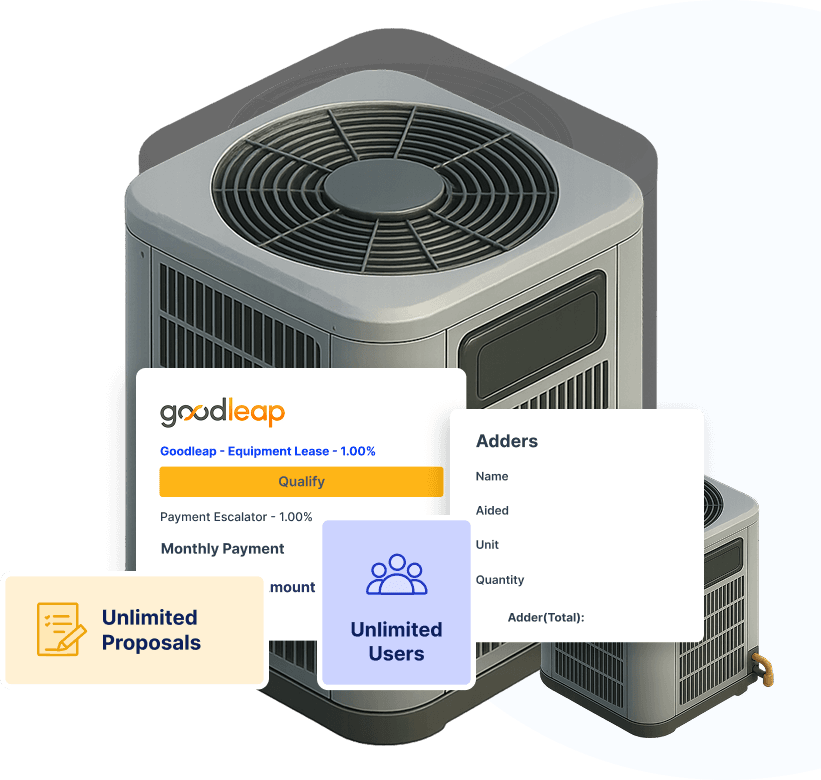
Installation Businesses Are Different. Their Software Should Be Too.
ServiceTitan and Housecall Pro were built for reactive service calls — dispatch a tech, fix the unit, invoice the customer. That workflow doesn't match an HVAC installation business where your reps sell $8,000–$20,000 systems on-site, customers finance 60%+ of jobs, and ops manages multi-day installations across permits, equipment deliveries, and crew handoffs.
On-site proposals
EasyQuote lets reps build full HVAC system proposals on a tablet — equipment, accessories, financing options — and collect a signature at the homeowner's kitchen table.
Sales-to-install handoff
When a job closes in the sales pipeline, it auto-creates an installation project with all proposal details pre-loaded — zero re-entry, zero dropped specs between sales and ops.
Multi-stage milestones
Track every installation milestone: permit pull, equipment order confirmation, rough-in, final install, startup and commissioning, and inspection sign-off — all in one project board.
Financing in proposals
GoodLeap, Sungage, and LightReach are embedded directly into the proposal — reps show monthly payment options on-site, and financing approvals track inside the sales pipeline.

From First Lead to Final Commissioning — One Platform
Most HVAC installation companies run 3–5 disconnected tools. A CRM for leads, a separate quoting tool, a finance app, and spreadsheets for scheduling crews and tracking permits.
SubcontractorHub replaces the stack. Your reps close faster with AI proposals at the door. Financing is embedded at the point of sale. When a job closes, it flows automatically into the installation project management board — no re-entry, no calls between sales and ops.
See the Platform
Installation Project Management Built for HVAC
HVAC installations aren't same-day service calls. They involve multiple crew visits, equipment lead times, permit inspections, and customer coordination across days or weeks.
SubcontractorHub's project management tracks every stage — from equipment order through final commissioning — with crew scheduling, permit status, and customer communication all connected to the same job record that started in your sales pipeline.
Book a DemoSubcontractorHub is the right fit if:
Built for HVAC installation businesses that are scaling beyond what disconnected tools can handle.
Talk to the TeamYou sell and install HVAC systems — not just repair service calls
Reps close deals with on-site proposals and close rate matters
Customers finance 50%+ of jobs and you need financing in the proposal
Sales hands off to ops and details get lost in the handoff
You're running 10+ installations per month and tracking milestones manually
You also do roofing or solar and want one platform for all trades
Common Questions
What is HVAC installation software?
HVAC installation software is a business management platform built specifically for companies that sell and install HVAC systems. It connects the sales cycle (proposals, CRM, financing) with the installation workflow (permits, equipment orders, crew scheduling, multi-stage project milestones) in one platform — unlike field service tools built for reactive repair calls.
How is HVAC installation software different from HVAC field service software?
Field service tools are built for reactive service calls — dispatch a tech, fix the unit, close the invoice. HVAC installation software is built for companies that sell and install full systems: managing a sales pipeline, generating proposals with financing, and running multi-week installation projects that require permit tracking, equipment ordering, and multi-stage crew scheduling.
What should HVAC installation software include?
Look for: AI-powered on-site proposal generation, a sales CRM to manage leads from first contact to signed contract, embedded financing options presented at the point of sale, multi-stage installation project management (permit, equipment delivery, rough-in, final commissioning), crew scheduling, and manager dashboards showing pipeline and installation status in one view.
Does SubcontractorHub work for HVAC companies that also do roofing or solar?
Yes — SubcontractorHub was built for multi-trade contractors. Your team can quote roofing, solar, and HVAC jobs in the same proposal, and managers see all three pipelines and installation projects in one dashboard.
How long does onboarding take?
Most HVAC installation teams are live within a week. Compare that to ServiceTitan's 6–8 week mandatory onboarding and $15,000–$25,000 setup fee.
Ready to See It in Action?
Book a demo and see how SubcontractorHub connects your HVAC sales team, proposals, financing, and installation operations in one platform.
Book a Free DemoWhat Breaks on an HVAC Install — and Where Software Actually Helps
Replacement and new-construction installs fail in four predictable places, and none of them are the install itself. They are sizing, equipment availability, permits, and commissioning paperwork — the parts that happen before and after the crew is on site.
Sizing has to survive the handoff to the proposal
A load calculation done properly and then ignored at quoting time is worse than none at all, because it creates a paper trail showing you knew. When the load figure lives in one spreadsheet and the proposal is built in another, the equipment that gets quoted is whatever the comparable job used. Keeping the sizing basis attached to the job record is what stops a three-ton recommendation becoming a four-ton quote. Run the numbers with the Manual J load calculator and see the load calculation guide for why oversizing costs comfort and equipment life.
Equipment lead times are now a scheduling input
Sold-then-unavailable is the most expensive failure in installation work: the customer has signed, the crew is booked, and the unit is eight weeks out. Tying the equipment order to the job record — and scheduling the crew against the confirmed delivery rather than the sale date — is a boring capability that prevents the single most damaging kind of reschedule.
Permits and inspections are a pipeline stage, not an afterthought
Mechanical permits, gas line sign-off, and final inspection each have their own clock, and in many jurisdictions the install cannot be invoiced until inspection passes. Treating permit status as a visible stage in the job — rather than something the office remembers — is what keeps a completed install from sitting unbilled for three weeks.
Commissioning is where the warranty claim is won or lost
Refrigerant charge, static pressure, airflow, and temperature split recorded at commissioning are what a manufacturer asks for when a compressor fails in year three. Capturing them against the job at the time — with photos — is the difference between a covered warranty claim and an argument you lose. It is also the fastest way to close out a callback claiming the system “never worked right.” See the full HVAC platform for how commissioning data ties back to the service record.