
Commercial HVAC Software Built to Close Jobs and Deliver Them
AI proposals, sales CRM, embedded financing, and installation project management — one platform from first lead to final commissioning.
See It in Action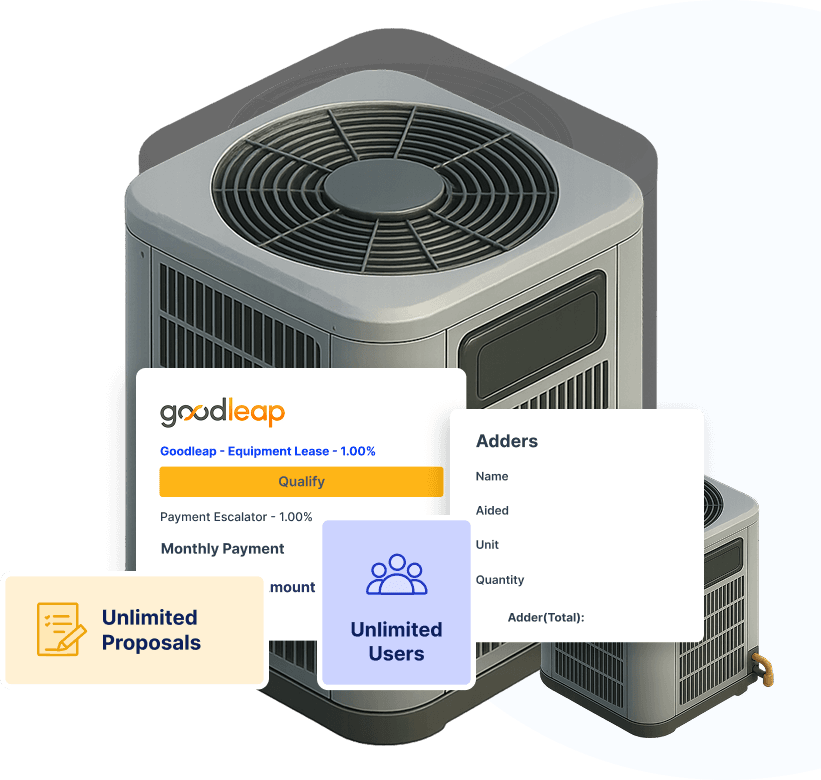
Every Stage of the HVAC Job, Connected
Quote multi-tier systems
EasyQuote builds HVAC proposals with good-better-best equipment options, adders, and embedded financing — reps present and collect a signature on a tablet before leaving the job site.
Track every lead
Sales Velocity gives managers real-time visibility into every open HVAC lead — rep activity, follow-up timing, financing status, and pipeline value — without chasing status updates.
Zero re-entry at close
When a job signs, every detail flows directly into project management. No email handoff, no data re-entry — operations gets a ready-to-schedule HVAC installation project instantly.
Financing in every proposal
GoodLeap, Sungage, and LightReach are embedded directly inside proposals. Reps present monthly payment options at point of sale — approvals track in the same pipeline record.

Replace the 3-Tool Stack With One Platform
Most commercial HVAC contractors are running a separate CRM, a separate estimating tool, a separate project management app, and a lender portal — none of which talk to each other. Every gap between those tools is a place a job can fall through.
SubcontractorHub replaces the stack. AI proposals close faster at the job site. Financing is embedded at the point of sale. And when a job closes, it flows straight into a scheduled installation project — zero re-entry, zero dropped handoffs.
See the Platform
Multi-Phase Installation Management Built for HVAC
HVAC installations are multi-week projects: permit filing, equipment delivery, rough-in, finish, inspection, final commissioning. Generic project tools weren't built for this timeline.
SubcontractorHub's project management tracks every milestone from permit to sign-off — with crew scheduling, material delivery coordination, and inspection tracking all connected to the original proposal and financing record.
Book a DemoSubcontractorHub is the right fit if:
The platform is built for HVAC installation contractors who are scaling beyond what spreadsheets and disconnected tools can handle.
Talk to the TeamYou sell and install HVAC systems — residential or light commercial
Reps present proposals on-site and close rates directly affect revenue
Financing is how a significant portion of your customers pay
You're managing 10+ installs per month and ops handoffs are costing time
You're running 3+ tools that don't talk to each other
You also do roofing or solar and want one platform across all trades
What “Commercial” Means Here — and Where the Line Is
“Commercial HVAC” covers two businesses that share a name and almost nothing else. Being clear about which one you run saves a lot of wasted evaluation time.
The first is sell-and-install work: rooftop and split system replacements, light commercial retrofits, small-building new installs, often sold alongside residential. Deals are won on a proposal, frequently financed, and delivered as one scope over days or weeks. Growth comes from close rate and throughput. This is what SubcontractorHub is built for — multi-tier proposals signed on site, financing presented at the point of sale, and the signed job flowing straight into installation project management with no re-entry.
The second is commercial mechanical contracting: bid-and-build work under a general contractor, multi-year service agreements across building portfolios, monthly pay applications against an approved schedule of values, retainage, and subcontractor tiers. Growth comes from contract volume and billing discipline. That work needs construction contract accounting, and a sales-led platform is not a substitute for it.
Most contractors sit somewhere between the two, and the honest test is where the revenue comes from. If most jobs are won by presenting a proposal to an owner or property manager, the sales-and-install stack is the constraint worth fixing. If most jobs are won by submitting a bid and then billing progress payments for months, start with the billing system.
For the contract-billing side of the business, two guides cover the mechanics in detail: how progress billing and the AIA G702/G703 forms work and how retainage is calculated and released. For tracking cost against estimate on installation work, HVAC job costing covers what the platform does track. And if you also run residential volume, embedded customer financing is the fastest way to shorten the gap between finishing work and being paid for it — the lender funds you promptly, with no certification step and no retainage.
Service Contracts and Preventive Maintenance Tracking
Most commercial HVAC revenue is not construction. It is recurring service under contract: quarterly preventive maintenance across a portfolio of buildings, demand calls against an agreement, and the replacement work those visits uncover. Software built for residential service treats each of those as an isolated call, which is why the office ends up reconstructing contract coverage in a spreadsheet.
Commercial maintenance tracking has to answer a different question: not “what happened on this job” but “are we current on every obligation we sold across this account, and is the contract still profitable?”
Contracts across a portfolio
One customer, twenty buildings, and a different scope at each. Track the equipment list, visit frequency and covered tasks per site while still seeing the account rolled up — including which sites are consuming more labor than the contract priced.
PM visits that generate themselves
Quarterly and semi-annual visits auto-generate from the agreement rather than depending on someone remembering. Missed PM visits are the most common reason a commercial agreement is not renewed, and they are entirely preventable.
Equipment history at the asset
Service history attached to the rooftop unit, not just the address. A technician arriving at RTU-7 should see what was done last visit, what was flagged, and what parts fit it — which is also how replacement recommendations get made credibly.
Contract profitability
Labor and parts posted against the agreement, so you can see which contracts are earning and which are being consumed by demand calls. Renewal season is the wrong time to discover a flagship account has been losing money for two years.
Field service and construction also have to coexist. A commercial mechanical contractor runs a service department dispatching demand calls and a construction side bidding projects, and the same technicians frequently move between them. Splitting those across two systems means nobody can see true labor capacity, and job costing on the construction side quietly excludes the hours that went to service.
Where the line is. SubcontractorHub covers service agreements and maintenance tracking for contractors whose business also runs on selling and installing systems. If your growth is driven almost entirely by service-contract volume — hundreds of agreements, a large dispatch desk, and little installation sales — a dedicated commercial service platform such as BuildOps is the more honest recommendation. We would rather say that now than during implementation.
Related: service agreement software, best HVAC maintenance software, service agreement platforms compared, and the maintenance plan pricing calculator.
Common Questions
What is commercial HVAC software?
Commercial HVAC software is a business management platform for HVAC contractors that combines a sales CRM, AI-powered proposals, embedded financing, and installation project management in one place. The best platforms handle the full job lifecycle — from first lead through final commissioning — without requiring separate tools for each stage.
How is commercial HVAC software different from residential HVAC software?
Commercial HVAC jobs involve more complex system configurations, longer sales cycles, multi-phase permitting, and larger deal sizes. SubcontractorHub handles both residential and light commercial HVAC installations in one platform — the same proposal builder, CRM, and project management tools scale across both.
What features should commercial HVAC software include?
Look for: a sales CRM that matches your installation sales cycle, AI-powered proposals with multi-tier system configurations, embedded financing (GoodLeap, Sungage, LightReach), project management with permit and inspection milestone tracking, and manager dashboards for pipeline and project visibility across the whole business.
Can SubcontractorHub handle HVAC companies that also do roofing or solar?
Yes — SubcontractorHub was built for multi-trade contractors. Reps quote HVAC, roofing, and solar from one platform, and managers see pipeline and project data across all trades in a single dashboard.
How quickly can an HVAC company get started?
Most teams are live within a week. Onboarding covers your price catalog, pipeline stages, financing partner connections, and rep training on EasyQuote. No long implementation timeline.
Does SubcontractorHub handle AIA progress billing and retainage on commercial contracts?
SubcontractorHub is built for sell-and-install contractors working on residential through light commercial systems, where jobs are quoted, financed, and delivered as a single scope. It is not a heavy commercial construction accounting package, so contractors billing monthly pay applications on AIA G702 and G703 forms against an approved schedule of values will typically keep that process in their construction accounting system. If most of your revenue comes from bid-and-build contracts under a general contractor, a platform purpose-built for commercial contract billing is the better fit — and our progress billing guide explains how that workflow operates.
How does SubcontractorHub compare to ServiceTitan or BuildOps for commercial HVAC?
They solve different problems. BuildOps and similar platforms are aimed at commercial mechanical contractors running service agreements and contract billing at scale. ServiceTitan is strongest as a residential service and dispatch system. SubcontractorHub is built for the sales-and-installation side: multi-tier proposals presented and signed on site, financing embedded at the point of sale, and the signed job flowing into installation project management without re-entry. Contractors whose growth depends on close rate and proposal quality tend to fit SubcontractorHub; contractors whose growth depends on service contract volume usually do not.
Does commercial HVAC software handle preventive maintenance contracts?
It should do more than store them. Commercial preventive maintenance means a defined scope per site across a portfolio of buildings, visits that auto-generate on a quarterly or semi-annual cadence, and service history attached to individual equipment rather than to an address. It also means tracking labor and parts against the agreement so you can see which contracts are still profitable. Missed PM visits are the most common reason a commercial agreement is not renewed, and they are entirely preventable with the right scheduling.
What is the best software for commercial HVAC maintenance tracking?
The honest answer depends on your mix. If maintenance contracts are the business — hundreds of agreements, a large dispatch desk, little installation sales — a dedicated commercial service platform such as BuildOps is built for that shape and we would point you there. If maintenance work sits alongside a real installation and replacement business, running both in one system matters more than depth in either, because otherwise nobody can see true technician capacity and construction job costing silently excludes hours spent on service.
Can it track service across multiple buildings for one customer?
Yes. A commercial HVAC customer is usually one account with many sites, each with its own equipment list, access requirements and contract scope. Keeping the account hierarchy intact means you can see cost and margin at a single building or rolled up across the whole portfolio — which is what you need at renewal, when the question is whether the account as a whole is worth keeping at the current price.
Ready to See It in Action?
Book a demo and see how SubcontractorHub connects your HVAC sales team, proposals, financing, and installation operations in one platform.
Book a Free DemoResources
HVAC Guides & Comparisons
- Best Commercial HVAC Software in 2026
- Construction Progress Billing: AIA G702/G703 Explained
- Best HVAC Job Costing Software in 2026
- HVAC Platform Overview
- HVAC Contractor Software
- HVAC Lead Management Software
- Best HVAC Lead Management Software in 2026
- Best HVAC CRM Software in 2026
- Best HVAC Software for Contractors in 2026
- Best HVAC Sales Software in 2026
- Best HVAC Estimating Software in 2026
- How Much Does HVAC Software Cost?
- HVAC Proposal Software
- HVAC Estimating Software
- Contractor Financing — Built Into Every Proposal
- GoodLeap Financing for HVAC Contractors
- Best HouseCall Pro Alternatives
- Best ServiceTitan Alternatives
- All Contractor Software Features
- HVAC Equipment Rep Software
- Commercial Contractor Software
- Mechanical Contractor Software
- Construction Billing Software